

Selectivity Analysis Arc Flash – Step 6 Explained
Step 6: Selectivity Analysis in Arc Flash Studies
Author: Marcin Ruta
Primary topic: Protective Device Coordination and Arc Flash
Reading time: 4 min read
What Is Selectivity Analysis in Arc Flash Studies?
It can be also called Protective Device Coordination (PDC), Selectivity Study, Discrimination Study. It is usually mandatory analysis for new electrical installations but also applies for upgrades, retrofits, or major electrical installation modernizations. Protective Device Coordination is a proper selection and settings of protective devices in order to isolate only faulted branch or place. If made properly, it will limit damage to installation itself and connected devices. A very important part of Selectivity Analysis is to eliminate fault as close as possible to the source of fault without affecting operation of the system.
Why Is Selectivity Analysis Important for Arc Flash?
Non-selective protection system can increase damage to the equipment, extend and expand downtime and costs related. In some cases it can lead to dangerous situation especially related with safety like fire, shock hazard, automatic disconnection or arc flash etc. In some cases it may not react at all, and obviously we don’t want it.
How Does Selectivity Analysis Affect Arc Flash Results?
Arc Flash calculation requires us to determine protective device tripping time. In previous steps, we already modelled all necessary protective devices like:
- LV fuses
- LV breakers (ACB, MCCB, MCB)
- MV breakers with protection relays (electromechanical, digital)
- MV fuses
- and specific protection schemes like differential protection, fibre optic arc detection, arc quenching devices, arc flash reduction maintenance switches, etc.
Arc flash and selectivity requirements are usually contradictory, and it requires compromise in some situations. In order to lower arc flash incident energy, tripping time need to be as low as possible (faster tripping). On the other hand, standard selectivity requirements are pushing tripping time higher (slower tripping). There are hardware solutions that can overcome this problem, but they are not always available or feasible (due to cost, retrofit possibility or technical issues).
Selectivity and Arc Flash?
Arc Flash analysis itself doesn’t require the system to be selective, however it is very useful to perform such analysis. This step is important as it allows us later to provide tailor made recommendations for improvements of selectivity and arc flash. Protective device coordination is a much bigger topic, and it is very often omitted in arc flash analysis leading to identification of only existing situation while good practice is to focus on possible improvements. In order to do it right, we need to identify system issues like:
- wrong settings of protective devices
- non-selective areas
- under protected equipment like cables, transformers, switchgears, and motors
The best way is to split analysis in two parts:
- first step is providing information for “as build” or “existing” situation
- second step is providing recommendations for selectivity and arc flash improvements
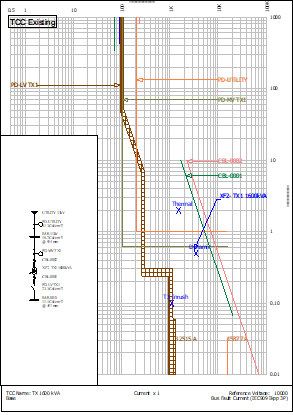
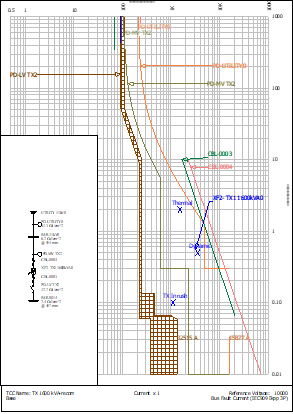
Below sample of two TCC’s for existing and recommended selectivity for transformer branch.
Selectivity Analysis Findings and Observations
Left TCC shows a partially selective system, and it can be seen that MV relays are set with definite time settings, which is very common practice. There are few areas which can be discussed here:
- Overlapping overload LV and MV settings may lead to MV side nuisance tripping, which we don’t want as it will de-energize the complete system and access to MV substation may be restricted or not possible.
- MV and LV side transformer cables are not protected properly against short circuit currents
- Transformer short circuit protection can be improved for primary and secondary faults
- Overall arc flash results for 11kV and 415V switchgears can be improved
Arc Flash Results Comparison – Existing vs Recommended
| Component | Existing IE cal/cm2 | Recommended IE cal/cm2 |
| BUS-11kV | 18.2 | 6.18 |
| BUS-LV 415V | 11.1 | 2.4 |
It needs to be noted that in some situations it is a compromise. This means that in order to improve arc flash results, we will sacrifice selectivity and vice versa. This doesn’t happen very often and nowadays, we can use communication based protection solutions, interlocking schemes, arc flash maintenance switches to name a few.
Would you like to know more?

Marcin Ruta
Electrical Safety Consultant
MR Power Systems