ARC FLASH SAFETY From Theory to Practice
A practical guide for electrical engineers and safety professionals
Marcin Ruta | MR Power Systems | POLAND
Author: Marcin Ruta
Primary topic: Arc Flash Safety and Risk Assessment
Standards mentioned: IEEE 1584, IEEE 1584.1, NFPA 70E, IEC 61482-1-1, IEC 61482-1-2, CSA Z462, DGUV-I 203-077, IEC 60909
Reading time: 10 min read
What Is Arc Flash?
Before diving into calculations, it helps to be precise about what arc flash is — and how it differs from a short circuit.
Short circuit vs arc fault
A short circuit (bolted fault) is a 1, 2 or 3-phase fault where impedance at the fault location is assumed to be zero or not, depends on calculations we need. It produces the theoretically maximum fault current and determines equipment interrupting ratings.
An arc fault is different. It is almost any fault that is not a short circuit fault — one with electrical arc formed (impedance) in the fault path, sometimes intermittent. The impedance of arc causes arc current to be lower than bolted fault value, but the arc generates an enormous release of heat and mechanical stress on the installation and personnel nearby.
Definition
Arc Flash Hazard (NFPA 70E-2024): A source of possible injury or damage to health associated with the release of energy caused by an electric arc. Risk increases when energized conductors are accessible during maintenance or operation.
LV vs MV — which is worse?
A common misconception is that high-voltage systems are automatically more dangerous. At medium voltage (10 kV), arcing current stays close to the bolted fault current level. At low voltage (400 V) the ratio drops steeply: at 50 kA bolted fault current, the arcing current may be only 37-50% of the bolted value so even down to 20kA in this example.
This means that at low voltage, with very high available fault currents, arc energy can reach extreme levels. The answer to ‘LV or MV worse?’ is: it depends on the installation. Without calculation, you do not know.
Do you know?
Where is the worst location for short-circuit stress in a typical MV/LV substation?
- MV switchgear 15 kV
- transformer 15/0.4 kV
- main 400 V circuit breaker?
Answer: the main LV CB (incoming panel) is almost always the worst — it sees full transformer fault current with the longest possible clearing time.
Standards — Knowing What You Are Working With
Arc flash safety uses a combination of standards. Understanding which apply to your situation — and how they interact — is a prerequisite for any study.
Most commonly used (EU and global):
- IEEE 1584-2018 — primary standard for arc flash incident energy calculations (AC, 208 V to 15 kV).
- IEEE 1584.1-2023 — requirements for performing arc flash studies.
- NFPA 70E-2024 or local version— primary reference for PPE selection, working distances, and electrical safety programme structure.
- IEC 61482-1-1 — open arc test for PPE (ELIM rating in cal/cm²), most relevant in Europe.
- CSA Z462-2024 — Canadian equivalent of NFPA 70E, used in some international projects.
Less common but technically significant:
- DGUV-I 203-077 — German guide using IEC 60909 short-circuit data; applies a 1-second maximum duration time rule (vs unlimited or 2 seconds in NFPA 70E — a key difference that significantly affects results).
- IEC 61482-1-2 — box test PPE (APC1 or APC2 classes) used to select PPE
Common practical approach in EU: IEEE 1584-2018 for calculation + NFPA 70E-2024 for PPE selection + IEC 61482-1-1 for PPE testing standard. The difference between DGUV203-077 and IEEE1584 is a critical and must be understood before choosing your methodology. Its not simple change
Arc Flash Boundary and Labels
Hazard zones
Arc flash hazard zones are distinct from shock hazard zones. The arc flash boundary is defined by energy: the distance at which incident energy decays to 1.2 cal/cm² — the onset of a second-degree burn on bare skin. In practice the arc flash boundary is often significantly larger than shock hazard zones.
Line side vs bus side
The upstream (line) side of an incoming circuit breaker is typically much more dangerous than the downstream (bus) side, because it is protected by the upstream device — which may have, a much longer clearing time. A real example: line side 37.1 cal/cm², bus side 2.85 cal/cm² on the same panel. Both need separate labels and separate PPE assessments.
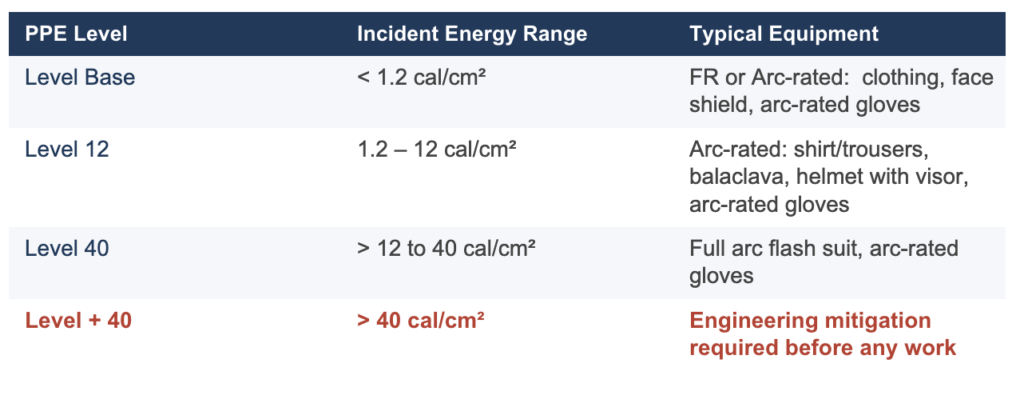
Arc flash label content (per IEEE 1584 / NFPA 70E)
A compliant label must include: nominal voltage level, incident energy (cal/cm²) at working distance, arc flash boundary, required PPE level and/or minimum arc rating or PPE Category
And optionally but very useful: location identifier, insulation glove class, shock hazard zones, line side or bus side, date of analysis, and the standard used.
The Hierarchy of Controls — Design First, PPE Last
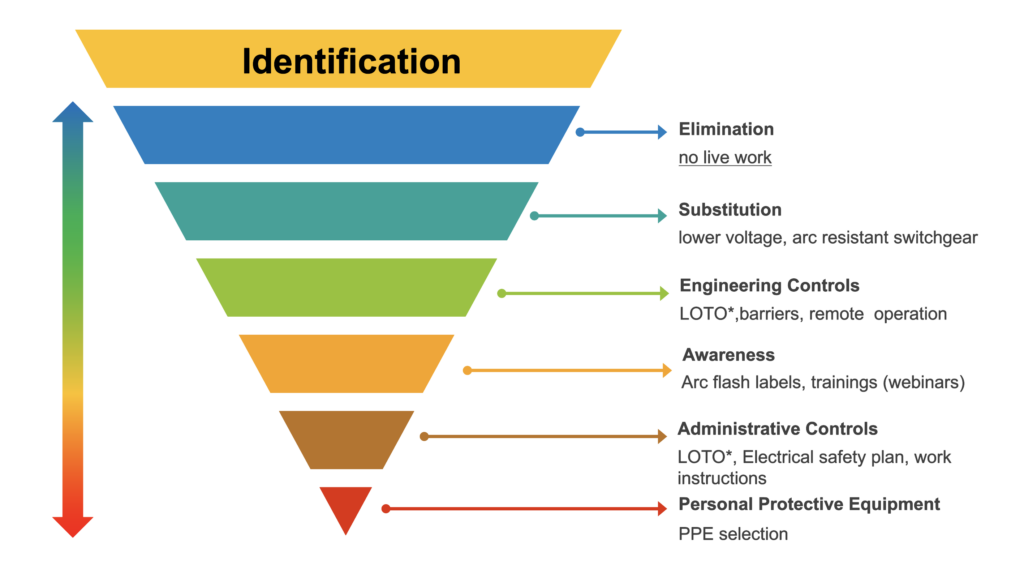
The correct approach follows the classical hierarchy: eliminate first, then substitute, then engineering controls, then administrative controls, then PPE. PPE is the last resort.
The problem becomes stark at extreme energies. No PPE exists at 200 cal/cm² or above. So before anyone opens a PPE catalogue, the energy must be brought down to a level where selection is even possible.
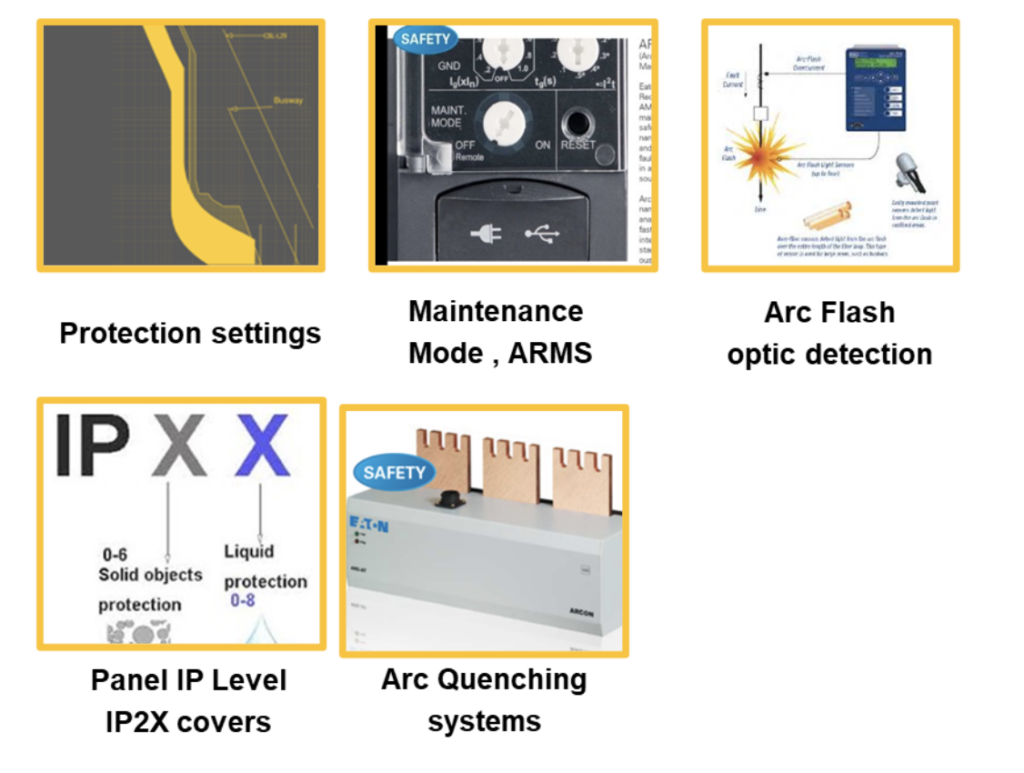
Five key mitigation tools
Protection setting optimisation: cheapest and most technically demanding. Reduce fault clearing times while preserving selectivity. Longer tripping times improve selectivity but increase arc energy — getting both right requires skilled engineering, but can transform the numbers without touching hardware.
Optical arc detection: light sensors that react to an arc flash far faster than overcurrent protection. Response time is decoupled from current-time settings.
Arc quenching systems: deliberately create a short circuit inside the panel, collapsing arc voltage to near zero. Results are dramatic: incident energy can drop from 100 cal/cm² to 0.1 cal/cm².
Maintenance mode : temporarily overrides protection settings with faster parameters for the duration of work. A lockout/tagout procedure must prevent deactivation during work.
Covers and separation forms: simplest and cheapest mitigation, most frequently overlooked. Easiest way to reduce likelihood.
Optimizing Protection Settings — A Real Project
The following case study shows what is achievable purely through engineering, without replacing any switchgear. Starting installation: MV/LV transformer substation ,a small part of much bigger electrical model.
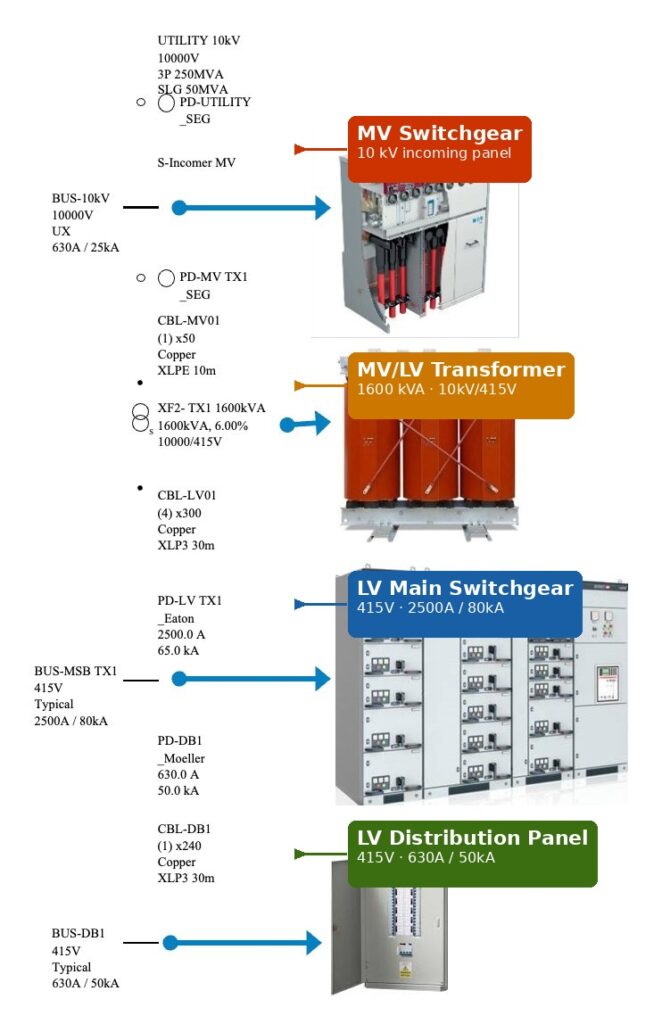
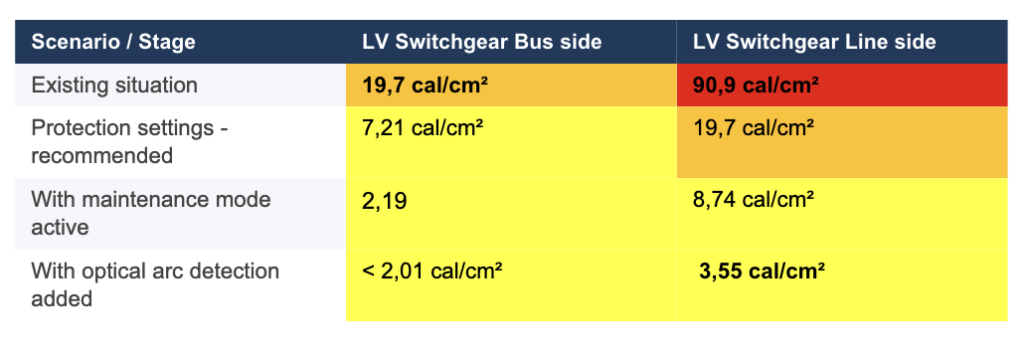
The entire improvement was achieved without replacing switchgear and withou hundred thousands to t multi-million investment. Purely through engineering: reprogramming the MV relay, reviewing LV trip units, activating maintenance mode, and adding optical arc detection.
At 90 cal/cm², PPE selection is irrelevant — there is no practica PPE to select, at least in Europe. At under 4 cal/cm², the hazard is fully manageable with standard arc-rated PPE. Same installation. Different settings. Dramatically different hazard profile.
IEEE 1584:2018 — The Calculation Framework
IEEE 1584:2018 equation application range:
voltages 208 V to 15 kV; 50/60 Hz;
bolted fault currents 500 A to 106 kA (LV) and 200 A to 65 kA (MV);
electrode gaps 6.35 mm to 254 mm.
Below 240 V and at fault currents below 2000 A, a three-phase arc is unlikely to sustain — which doesn’t make the system safe, but limits calculation applicability.
Step-by-step procedure:
- Select electrode configuration (VCB, VCBB, HCB, HOA, or VOA). HCB — horizontal electrodes facing the worker — is typically the worst case.
- Calculate intermediate arcing current at 600 V, 2700 V and 14300 V reference voltages using the polynomial equations in Table 1.
- Correct for actual system voltage — e.g. interpolate from the 600 V equation down to 415 V using Equation 25.
- Apply variation factor (VarCf) — actual arcing current may be lower than calculated. If it falls on the flat part of a time-current curve, tripping time and incident energy increase dramatically.
- Calculate enclosure correction factor (CF) — compares actual enclosure dimensions to the standard’s reference test dimensions.
- Calculate incident energy using the interpolated arcing current, clearing time, and CF.
- Calculate arc flash boundary — distance at which energy decays to 1.2 cal/cm².
Worked example: 2 MVA transformer at 415 V
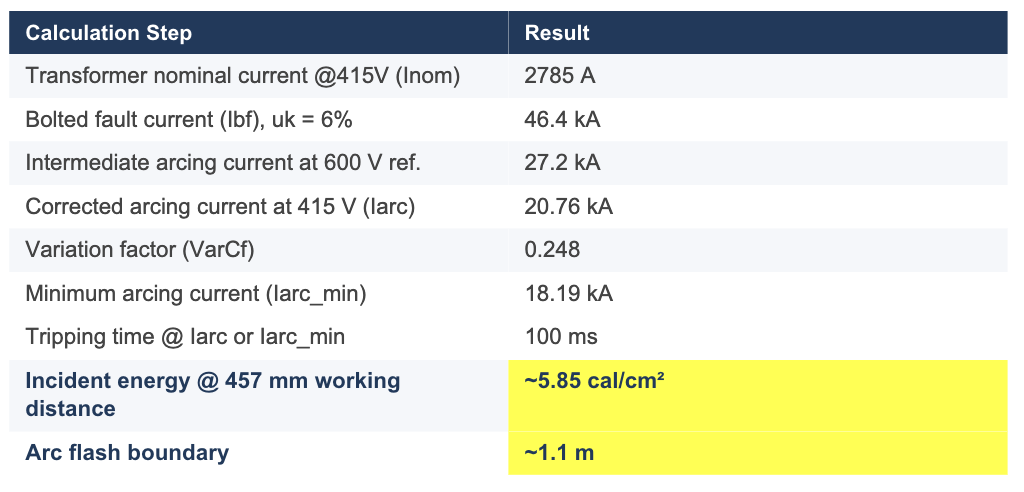
Why calculation software is not optional at scale
In softwares like ETAP, SKM, CYME and so on modifying one element triggers automatic recalculation of the entire model. In a spreadsheet, the same update can mean days of work per revision. The practical consequence: people stop updating their calculations — and an outdated arc flash study is more dangerous than no study at all.
NOT Fun Fact: Before you order the switchgear — check, calculate, verify. Once equipment is installed and the budget is spent, the money for upgrades are gone.
Data Quality — The Make-or-Break Factor
The most important observation from any arc flash study has nothing to do with calculations. It concerns the data that feeds them.
The single-line diagram is the foundation of every arc flash study. In the real world it is frequently ten to twenty years out of date, inconsistent with actual field configuration, and ambiguous — multiple transformers labelled ‘Tr1’, multiple breakers labelled ‘Q1’.
In one project, the model had to be started from satellite imagery. Getting usable data from clients can itself be a major challenge.
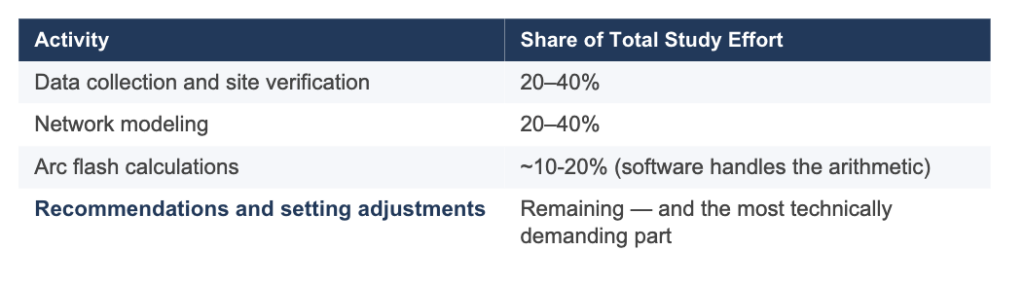
Knowing what to do with the results — adjusting settings without compromising protection coordination, proposing solutions that are actually implementable — is where the real expertise lies.
Conclusion
Arc flash safety is not about buying PPE randomly. It is a multi-layered system that begins at the design stage, runs through hazard identification, engineering solutions, electrical safety plans, and operating procedures, maintenance plans — and only then arrives at PPE selection as the final line of defence.
IEEE 1584:2018 provides a solid calculation framework, but it only works with reliable input data, a well-constructed network model, and engineering judgement. Calculation software does not replace knowledge — but without it, keeping arc flash studies current through every design revision is practically impossible.
PPE is the last line of defence, not the first. When incident energy exceeds 40 cal/cm², engineering mitigation must come before any PPE discussion. Protection settings optimisation alone can reduce incident energy by 50–80% — at zero hardware cost. The worst location in a typical MV/LV substation is almost always the main LV incoming panel, where full transformer fault current meets the longest clearing time.
Two things are worth remembering above all: outdated arc flash studies are worse than none, because they create false security. And data collection accounts for 30–40% of the total study effort — garbage in, garbage out.
Things to check
- Check how you selected PPE in the first place?
- Do you know your arc flash hazard incident energy ?
- Do you solve problems with PPE or as written above?
- Do you have locations above 40 cal/cm2 that can be improved ?
Would you like to know more?

Marcin Ruta
Electrical Safety Consultant
MR Power Systems