Tasks based Electrical Risk Matrix Lessons Learned
Marcin Ruta | MR Power Systems | POLAND
Author: Marcin Ruta
Primary topic: Task-Based Electrical Risk Assessment and PPE Selection
Standards mentioned: ISO 45001, PN-N-18001, NFPA 70E, IEEE 1584, DGUV 203-077, CSA Z462
Reading time: 9 min read
Arc Flash Risk Assessment
Risk assessment. What can be done to ensure that it does not become merely a formal obligation – a forgotten sheet in a binder or an exercise in creative table filling? This article is devoted to this issue.
Although the starting point is electrical hazards – in particular the risk of electric arc – the issues discussed are universal. In practice, risk assessment in electrical work is a difficult area to properly address. Is it even possible to capture its specificity in a simple, repeatable, and useful way?
In this article, we will discuss:
- What is the difference between hazard analysis and risk assessment?
- What are the consequences of weak processes?
- What can be done differently to make risk assessment actually work.
Hazard analysis and risk assessment – what is the difference?
The terms hazard and risk are often used interchangeably. I have heard many times—and I have to admit that I have also used—phrases such as “this is a major hazard” or “this is high-risk work.” They sound similar, but in fact they are different concepts.
Based on the approach of ISO 45001, PN-N-18001, and NFPA 70E, we can adopt simplified but very useful definitions:
- Hazard – a source of potential injury or deterioration of health. In electrical work, these include electric arc energy, electric shock, electromagnetic fields, and electrostatic charges.
- Probability – the chance or frequency of a given event occurring within a specified period of time (day, month, year).
- Risk– combination of hazard and probability of its occurrence.
This is most often written in simplified form:
Risk = Hazard × Probability
This is where resistance often arises: “It’s not gambling or poker – why do we need probability?” Ironically, the English word “hazard” means in polish “gambling.” But let’s leave word games aside.
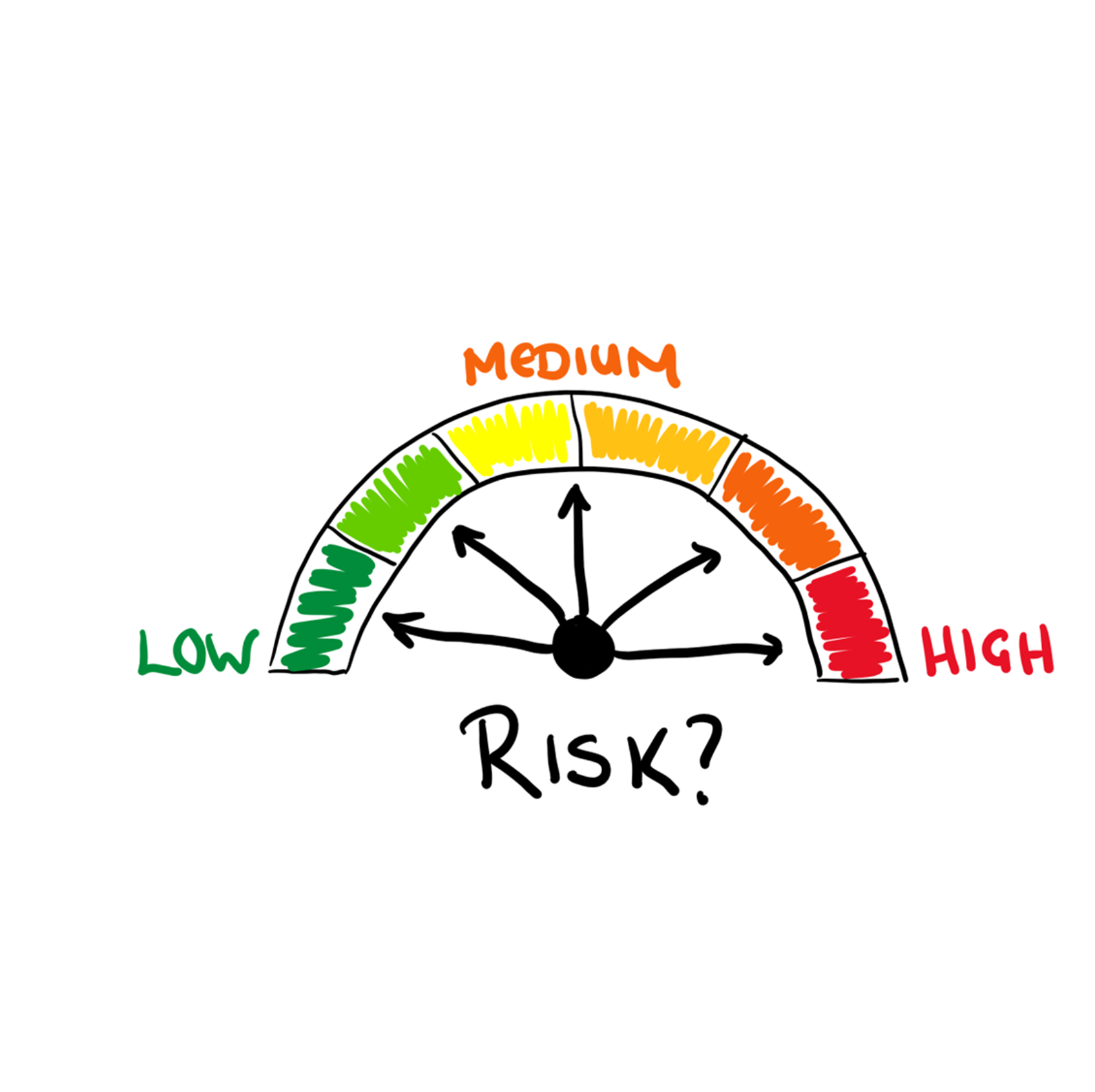
What hazard and risk mean in practice?
Hazard and risk are inseparably connected, but only by separating them do we gain real practical value.
Example:
The level of hazard from an electric arc is 7.6 cal/cm² (arc flash incident energy). This is a calculated value and difficult to dispute. However, the probability depends on what activities we perform, under what conditions, and on what equipment. What’s more, not every accident is the result of human error.
To assess this, we need a system: data, criteria, and a tool, such as a risk matrix.
The grey zone of probability
It’s hard to argue about the level of hazard — it’s numerical and measurable.
Probability, however, is a different story. In my experience, this is exactly what creates the so-called grey zone of risk assessment. Data is lacking, and subjective judgment easily leads to manipulating the outcome.
Example:
Voltage measurement on the main busbars of a 415 V / 2000 A switchgear, with an arc flash incident energy ( hazard )of 7.6 cal/cm².
Let’s assume a 3×3 scale:
- Hazard: arc flash – medium (2)
- • Probability: high (3)
Risk = 2 × 3 = 6
However, it is enough to arbitrarily reduce the probability to 1 for the risk to drop to 2 or 4. The difference is huge – and it may determine whether additional control measures or protective actions will be implemented.
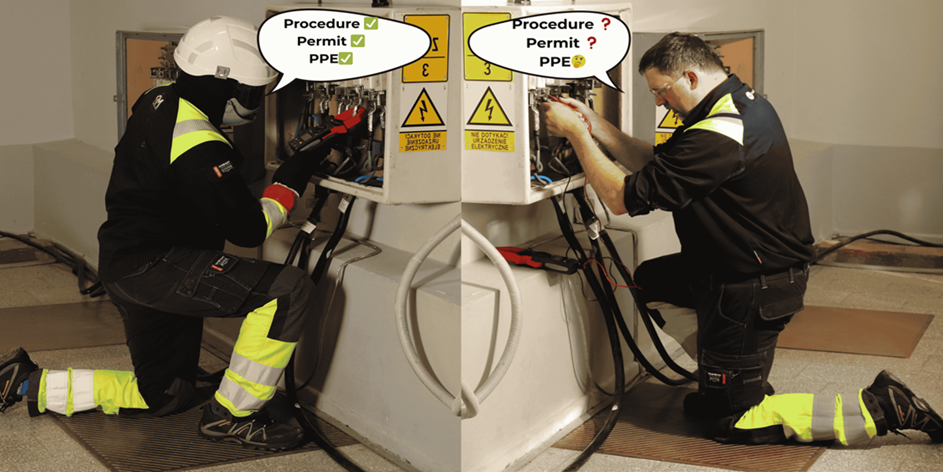
Consequences of incorrect risk assessment
An overly general assessment leads to:
- broad scope for interpretation of results,
- actions that are not applicable to actual risk,
- loss of employee confidence in the entire procedure,
- more serious injuries due to a lack of adequate protection,
- lack of repeatability.
On the other hand, an overly detailed assessment results in:
- mental overload for employees,
- impractical process,
- implementation resistance
- increased time and costs.
How to limit subjectivity?
Risk assessment will never be completely objective – but subjective part can be significantly reduced by:
- initial visual inspection,
- analysis of tasks performed,
- assessment of the technical condition of equipment,
- consideration of human factors,
- decision paths preparation
- PPE pre-selection
The goal should be simple, practical tools, not more procedures “on paper.”
Task-based PPE Selection Matrix – practical example
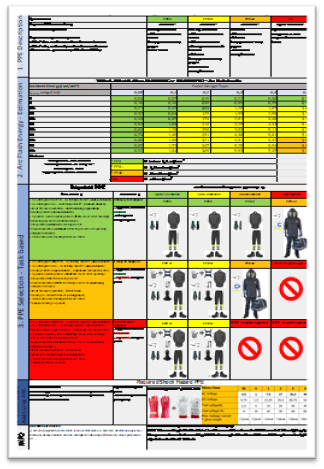
One such tool is the Task PPE Risk Matrix implemented by MR Power Systems. This is not a universal solution—it was designed for specific requirements and working environments—but it perfectly illustrates a practical approach.
The matrix takes into account, among other things:
- condition of equipment,
- type of hazards (arc flash, electric shock),
- list of tasks performed,
- preselection of PPE,
- probability assessment,
- final risk assessment.
As a result, most of the analytical work has been done in advance by specialists. The employee receives a tool that is ready to use.
How to create an electrical work risk assessment?
The presented model uses several key indicators:
- equipment assessment (condition, inspections, documentation),
- risk assessment (arc flash study, electric shock),
- list of tasks performed (e.g., from the electrical safety plan or operating manuals),
- PPE preselection matrix based on hazard assessment
- risk assessment.
What can be done about it?
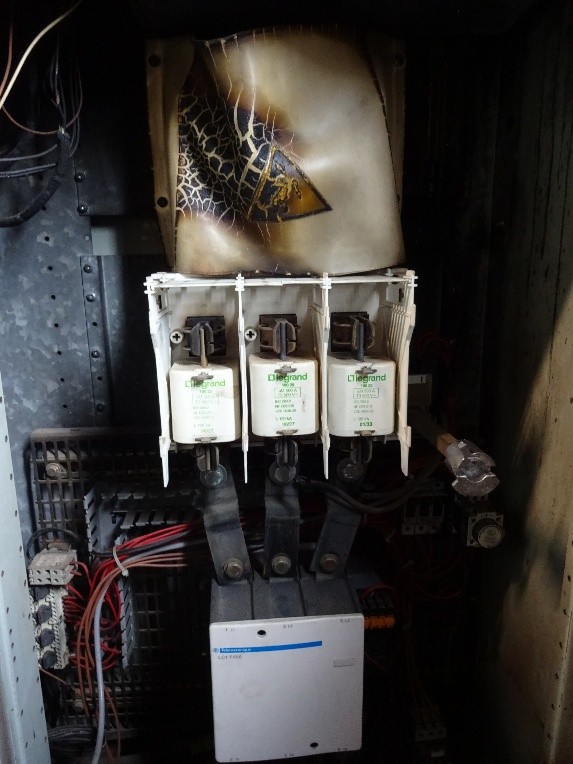
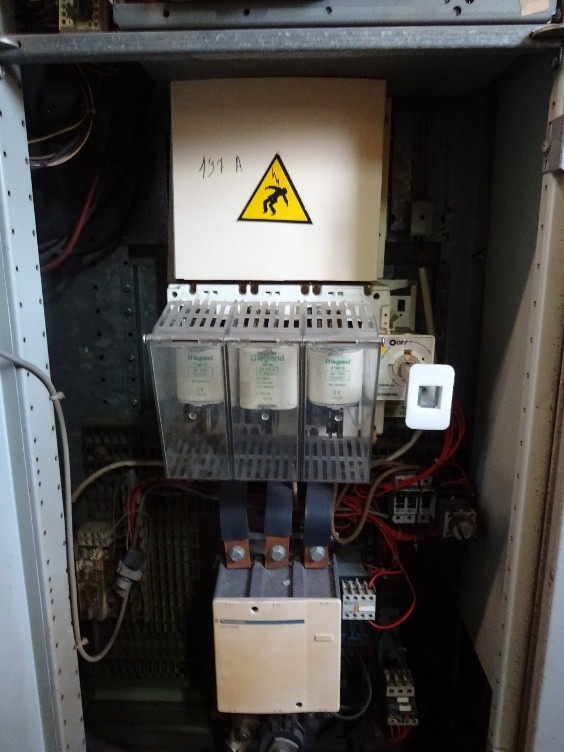
Condition of equipment:
1. The device is correctly installed.
2. The device is properly maintained.
3. The device is adapted to the available short-circuit current.
4. The device is used in accordance with the manufacturer’s documentation or instructions.
5. The device doors are closed and secured.
6. All covers are in place and secured.
7. There are no signs of an impending failure
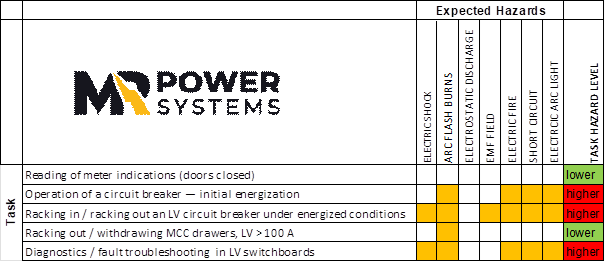
Task list:
- determining what work will be performed,
- assessing whether the work involves any specific hazard.
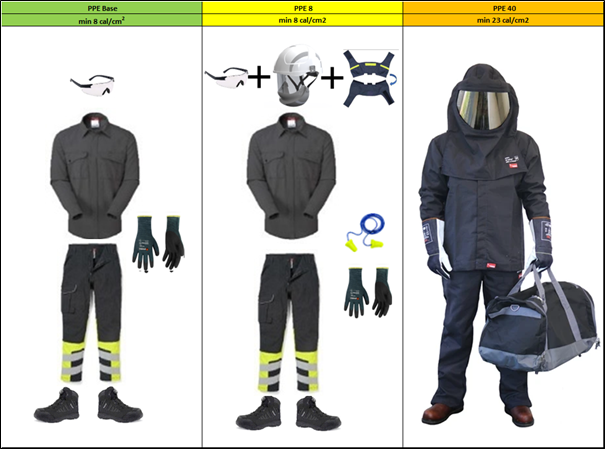
Wymagane poziomy ŚOI:
- preselection of PPE for use on the customer’s premises,
- specification of PPE protecting against electric arc burns,
- minimum PPE requirements (e.g., for subcontractors),
- specification of PPE protecting against electric shock,
- system for selecting and using PPE (e.g., multilayer, all-day, dedicated).
Determining likelihood:
- determination based on data or work analysis,
- assignment in a matrix (e.g., 2×2),
- determination of the impact of equipment condition on probability
| TASK LIKELIHOOD | Equipment Condition | ||
| Task description | Task Hazard level ↓ | Normal | Abnormal |
| Task group 1 | lower | Not Likely | Likely |
| Task group 2 | higher | Likely | Very Likely |
Hazard level
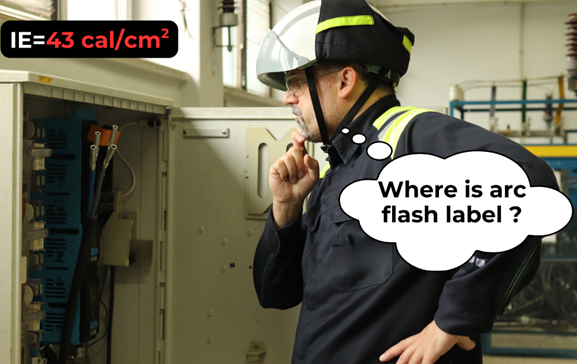
It refers to the incident energy level. There are several methods — and at least three common approaches — to determine it:
- Performing detailed arc-flash incident energy calculations (e.g., IEEE 1584, DGUV 203-077, DC calculation models)
- Using table-based approaches (e.g., NFPA 70E, CSA Z462)
- Applying predefined or pre-calculated incident energy values
Each approach has its benefits, but the key requirement is to obtain a dependable estimate of the potential arc-flash hazard. Among these options, the IEEE 1584 calculation method is the most comprehensive and is widely considered the preferred standard.
Example of arc flash pre-calculation
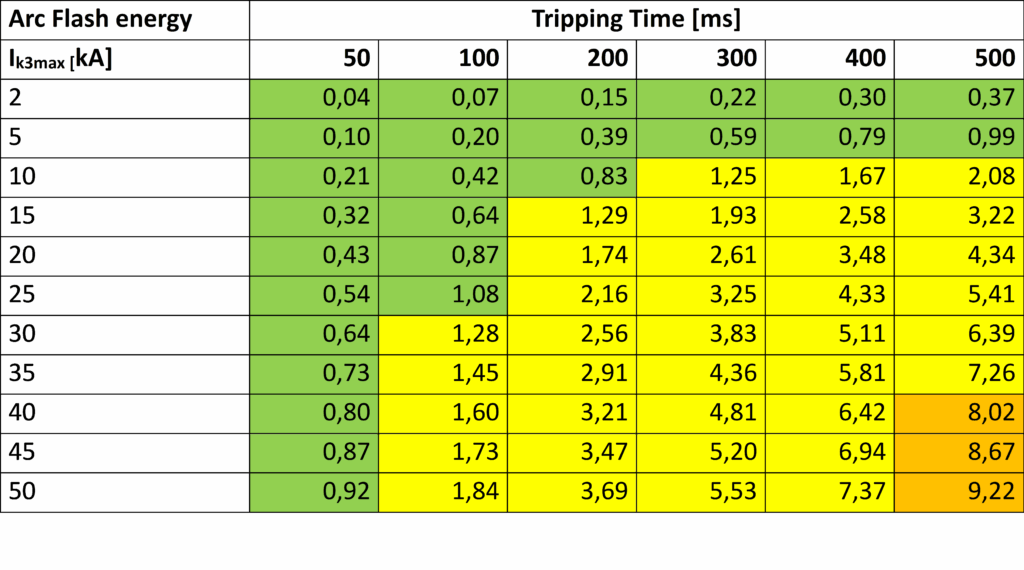
Because each stage carries the risk of error, this approach is suitable only when applied under strict oversight and should not serve as the primary method for determining arc-flash incident energy.
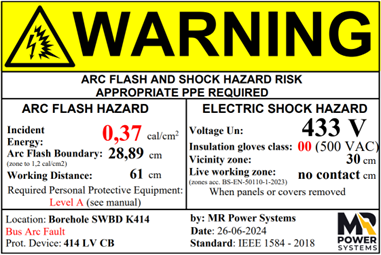
The final result
Ultimately, we obtain a PPE selection matrix for the work to be performed. It takes into account the condition of the switchgear, the type of work performed, exposure to live parts (e.g., unshielded busbars or cable terminals), and the level of risk.
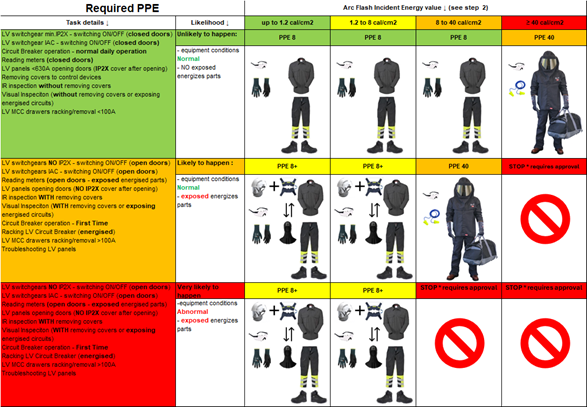
In this form, most of the analytical work has already been done by a specialist team. The tool can be easily verified based on real events or accidents. In the case described, the matrix was prepared for a large group working in service mode (i.e., not on their own installation). The list of tasks has been grouped and simplified to correspond to real situations.
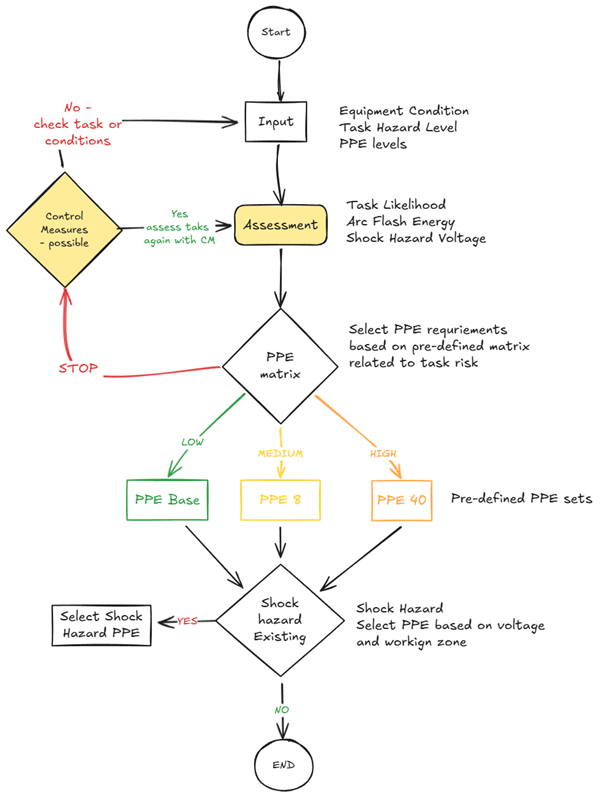
Inherent and residual risk – and the role of the control hierarchy
In classic risk assessment, we always talk about the situation before and after the application of mitigating measures. In the case of the task matrix, this pre-selection has been done in advance.
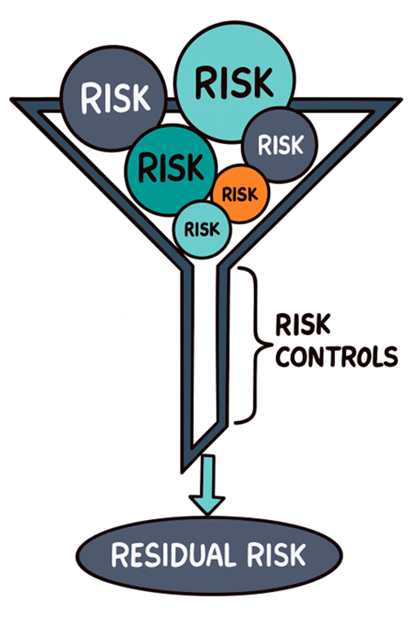
Here, it is worth referring to the control hierarchy according to NFPA 70E, which clearly shows that PPE is the last line of defense, not the only solution. Technical, organizational, and procedural measures are of key importance.
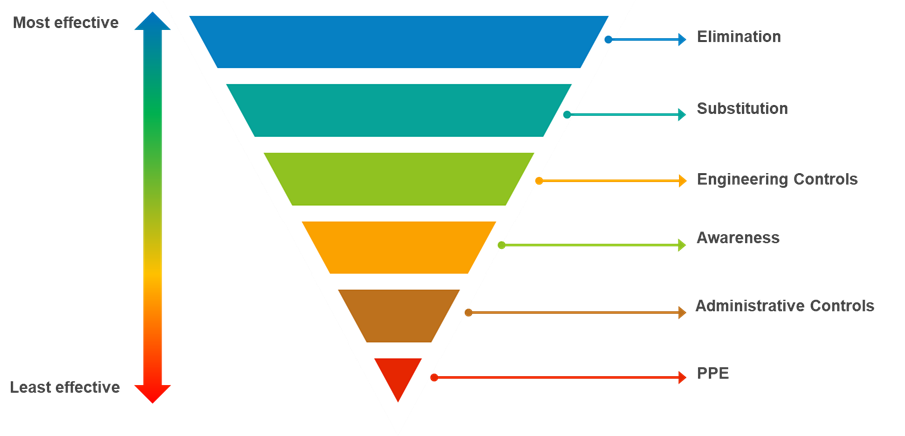
Two perspectives – one goal
From the perspective of:
- the employer – we implement solutions and eliminate risks,
- the employee – we use the measures provided.
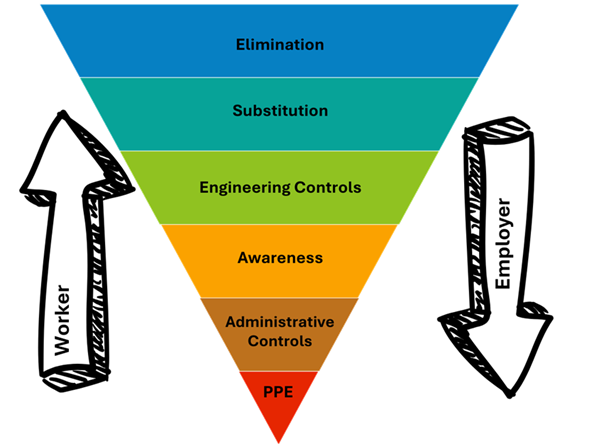
From the perspective of an employer, health and safety department, chief power engineer, or consultant, the process is the opposite of that from the employee’s point of view. First, we analyze how to eliminate or reduce the hazard, and then we expect the implemented solutions to be applied.
In practice, some measures only require technical implementation, while others require acceptance and understanding on the part of the staff. Although resistance to change is natural, solutions whose purpose is clearly communicated work best.
The matrix can be expanded to include a preselection of measures to reduce the risk or probability, which is justified because the employer bears the responsibility and has a decisive influence on the selection of solutions.
In practice, the biggest challenge is not technology, but acceptance of change. My experience shows that resistance is lower when people understand why we are implementing something.
Conclusions
- Probability should be based on data and analysis, not intuition.
- Matrices allow you to clearly define the minimum requirements for PPE.
Summary
The selection of PPE can only be made on the basis of a risk assessment. However, ignoring work procedures, the condition of equipment, and employee experience, it is easy to end up in a situation where we use full protection “always and everywhere.” Paradoxically, a well-designed matrix limits the use of PPE to places where it is really needed—and not where we are simply “afraid” to do something.
Would you like to know more?

Marcin Ruta
Electrical Safety Consultant
MR Power Systems