EN 50110: Key Requirements for Work on Electrical Installations
EN 50110: Key Requirements for Work on Electrical Installations
Author: Marcin Ruta
Main topic: EN 50110: Key Requirements for Work on Electrical Installations
Standards and regulations mentioned: EN 50110
Reading time: 10 min
Introduction to EN 50110: Key Requirements
The latest edition, PN-EN 50110-1:2024-04 “Operation of electrical installations – Part 1: General requirements”, is the cornerstone document for the safe operation of electrical installations across Europe. As a European Norm (EN), it sets out the minimum requirements and procedures for any work on, with, or near electrical installations.
In this article I walk through its most important points – the ones everyone involved in operating electrical installations should know.
Why does EN 50110 matter so much?
The provisions of EN 50110 have been carried over into Polish law – specifically the Regulation of the Minister of Energy of 28 August 2019 on occupational health and safety when working with energy equipment (Polish Journal of Laws, item 1830).
The 2024 edition covers some very important areas of electrical work, the standard itself is only about 50 pages long. The Polish regulation is just 11 pages long. That’s a short read, and I can promise you it clears up a lot.
If you want to go further, take a look at EN 50110-2. It collects the national annexes showing how other EU countries have adapted the standard – an interesting read, given how differently it has been implemented across Europe.
The main objectives of the standard are to:
- Establish uniform electrical safety guidelines,
- Minimise the risk of electrical accidents,
- Standardise basic working procedures,
- Protect workers’ lives and health
What can we learn from it?
EN 50110 has been partly absorbed into various national regulations and into other IEC and EN standards. Reading all of them tells you more about national requirements – but reading EN 50110 itself gives you a clear picture of the guidelines on:
- basic terms and definitions,
- personnel qualifications,
- organisation of electrical work,
- defining and determining hazardous zones,
- requirements for safety measures,
- descriptions of and recommendations on electrical hazards (electric shock, arc flash).
Key definitions
- Skilled person – someone with the training, knowledge and experience to carry out electrical work safely. (In Poland this is very clearly defined in the regulations covering qualification requirements and authorisations),
- Live working zone – the space where live work is directly carried out.
- Vicinity zone – the space surrounding the live working zone, around electrical equipment, with different levels of hazard.
- different levels of hazard.
This is a good place to quote the EN 50110 guidance on working zones:
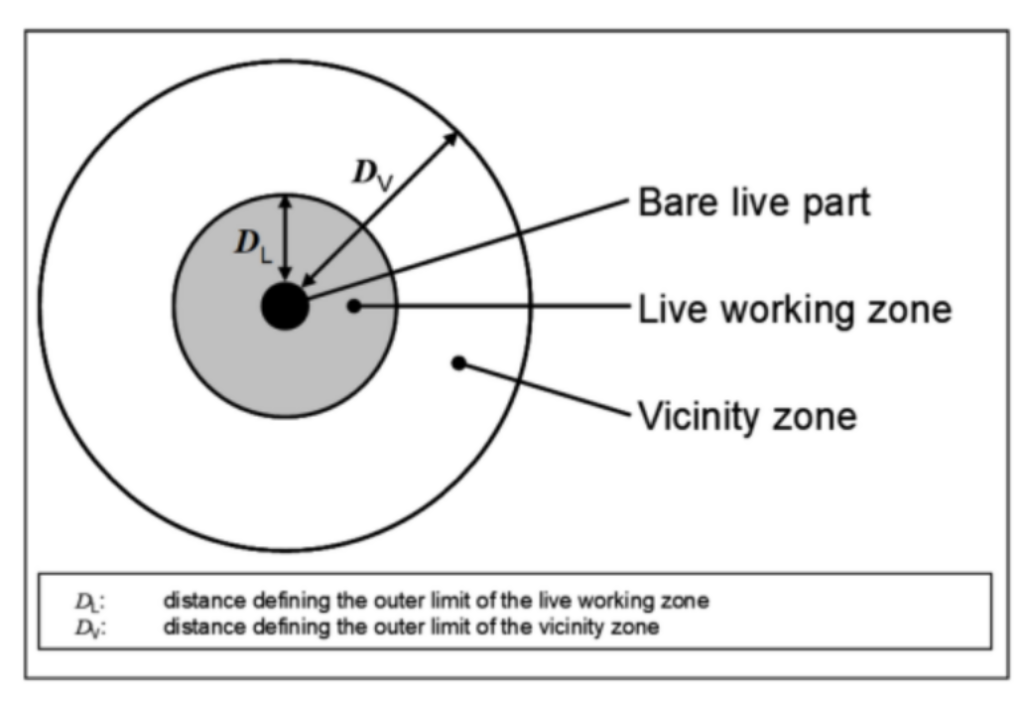
- DL – distance defining the outer limit of the live working zone,
- DV – distance defining the outer limit of the vicinity zone.
A real-world example
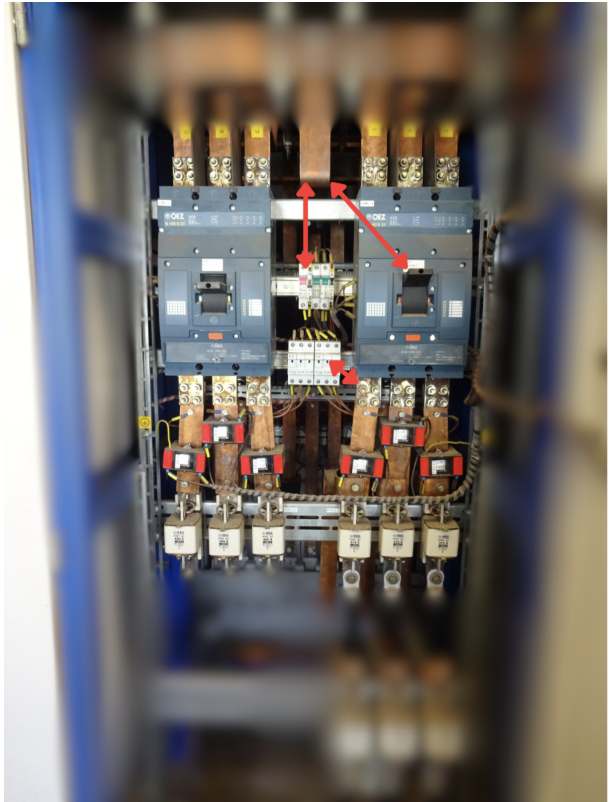
The photo below shows a section of a 415 V AC main switchboard. The outgoing feeder sections don’t achieve even the minimum IP2X degree of protection, exposing the electrician to both electric shock and arc-flash burns.
Because of the switchboard design alone, practically every switching operation here counts as particularly hazardous work. A trained eye will spot straight away that the minimum 30 cm distance (DL) can’t be maintained – and realistically it should be much larger once arc-flash hazards are taken into account. More on that in upcoming articles.
Distance tables
Table 1, EN 50110-1 – Estimated values for distances DL and DV
| Nominal system voltage UN (kV RMS) | DL – outer limit of live working zone (mm) | DV – outer limit of vicinity zone (mm) |
| ≤ 1 | no contact | 300 |
| 3 | 60 | 1 120 |
| 6 | 90 | 1 120 |
| 10 | 120 | 1 150 |
| 15 | 160 | 1 160 |
| 20 | 220 | 1 220 |
| 30 | 320 | 1 320 |
| 36 | 380 | 1 380 |
| 45 | 480 | 1 480 |
| 60 | 630 | 1 630 |
| 70 | 750 | 1 750 |
| 110 | 1 000 | 2 000 |
| 132 | 1 100 | 3 000 |
| 150 | 1 200 | 3 000 |
| 220 | 1 600 | 3 000 |
| 275 | 1 900 | 4 000 |
| 380 | 2 500 | 4 000 |
| 480 | 3 200 | 6 100 |
| 700 | 5 300 | 8 400 |
Note 1: intermediate values of DL and DV may be determined by linear interpolation.
Note 2: the values in Table 1 are intended as guidance for future harmonisation between countries.
And here is the corresponding table from the Polish Journal of Laws 2019, item 1830, defining the minimum clearances in air that mark the outer limit of each working zone:
Table 2, Polish Journal of Laws, item 1830 – Estimated values for live working, vicinity zones
| Nominal voltage of equipment or installation (kV) | Live working (mm) | Work in the vicinity of live parts (mm) |
| ≤ 1 | no contact | 300 |
| 3 | 60 | 1120 |
| 6 | 90 | 1120 |
| 10 | 120 | 1150 |
| 15 | 160 | 1160 |
| 20 | 220 | 1220 |
| 30 | 320 | 1320 |
| 110 | 1000 | 2000 |
| 220 | 1600 | 3000 |
| 400 | 2500 | 4000 |
| 750 | 5300 | 8400 |
Personnel requirements
EN 50110 itself doesn’t set requirements here – it leaves them to national law. That makes sense, since many European countries already regulate this area in detail. Where no such national rules exist, the standard’s own guidance is a solid fallback.
In Poland, this area is governed by Journal of Laws item 1830 along with a number of other regulations, which define:
- persons with designated functions (duty holders),
- authorised persons,
- qualified (certified) persons,
- employer responsibilities,
- training requirements,
- requirements for obtaining and verifying qualifications.
For comparison, here is how EN 50110 divides duties and defines areas of responsibility:
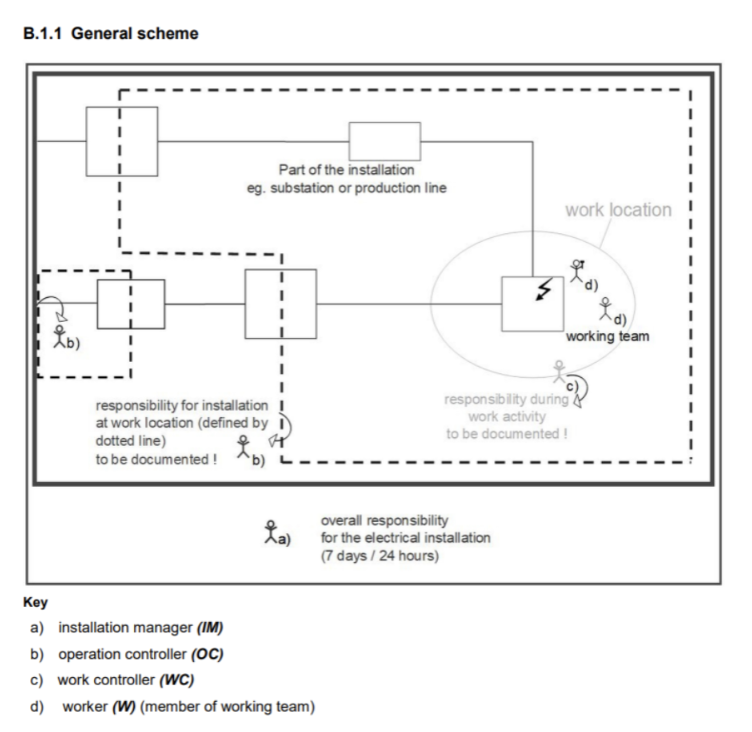
Table 3, EN 50110 Annex B.1.1 – roles and responsibilities
| Role | Responsibility |
| a) Installation manager (IM) | Overall responsibility for the electrical installation, 24/7 |
| b) Operation controller (OC) | Responsibility for the installation at the work location – to be documented |
| c) Work controller (WC) | Responsibility during the work activity – to be documented |
| d) Worker (W) | Member of the working team |
The five safety rules
- Disconnect completely and isolate (visible isolating gap),
- Secure against reconnection (e.g. a LOTO system),
- Verify that the installation is dead,
- Carry out earthing and short-circuiting (where required),
- Provide protection against adjacent live parts (i.e. shield or barrier any other parts of the circuit that remain live).
Organisational requirements
- Written work instructions / permits (where required),
- Designation of persons with specific functions,
- Risk assessment before work begins,
- Use of personal protective equipment.
EN 50110 also gives clear guidance on the basic principles of carrying out electrical work – something that’s far less obvious when you read the national regulations alone.
What the accident statistics say
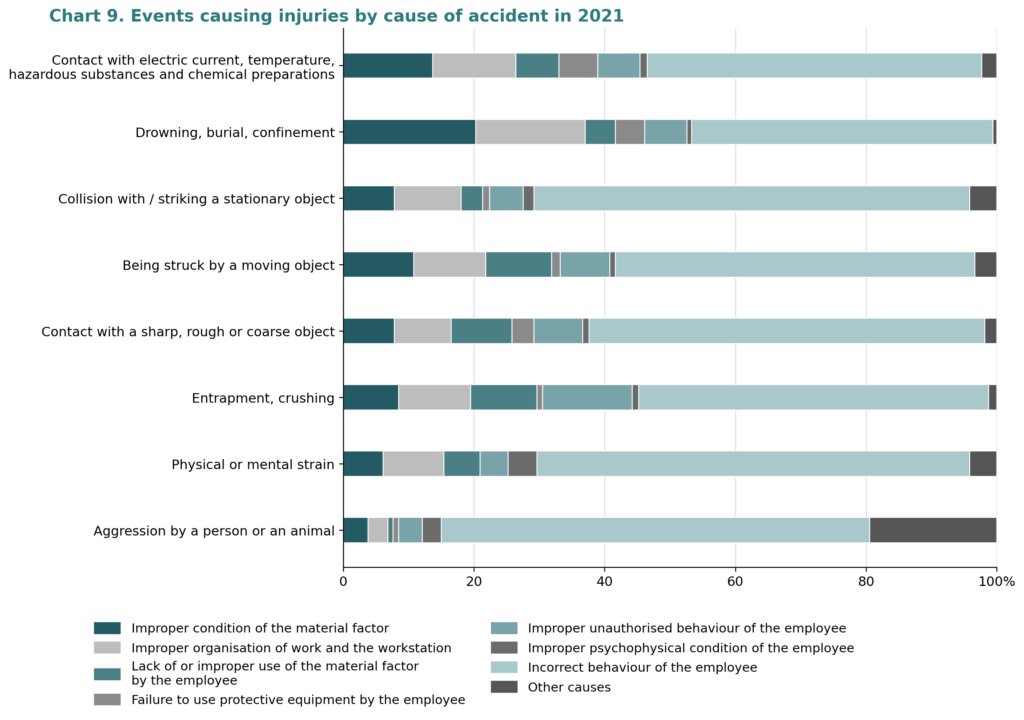
It’s worth looking at data from Statistics Poland (GUS). In 2021 there were 68,777 workplace accidents in total, of which 2,261 were classified as “contact with electric current, temperature, hazardous substances and chemical preparations” – a category that, admittedly, covers more than just electrical accidents.
Open question: the 2020 category value in the original repeats the 2020 total and should be checked against the GUS source.
Table 4, accident statistics (GUS)
| Year | All accidents | Contact with electric current, temperature, hazardous substances and chemicals |
| 2022 | 66,606 | 2,204 |
| 2021 | 68,777 | 2,261 |
| 2020 | 62,740 | 62,740 (to verify) |
| 2019 | 83,205 | 2,914 |
| 2018 | 84,304 | 3,009 |
| 2017 | 88,330 | 3,065 |
| 2016 | 87,886 | 2,820 |
| 2015 | 87,622 | 2,877 |
| 2014 | 88,641 | 2,781 |
| 2013 | 88,267 | 2,827 |
| 2012 | 91,000 | 2,966 |
| 2011 | 97,222 | 3,202 |
| 2010 | 94,207 | 3,350 |
Looking at the recorded causes, inadequate work organisation and improper worker behaviour accounted for more than 60% of all causes. That’s exactly why it’s so important to understand that proper procedures for electrical work exist – and that they make a real difference in protecting people from the hazards of electrical installations.
Summary
EN 50110 is a comprehensive set of guidelines that:
- define safe working procedures,
- protect workers’ lives and health,
- standardise the approach to electrical safety,
- reduce the risk of accidents.